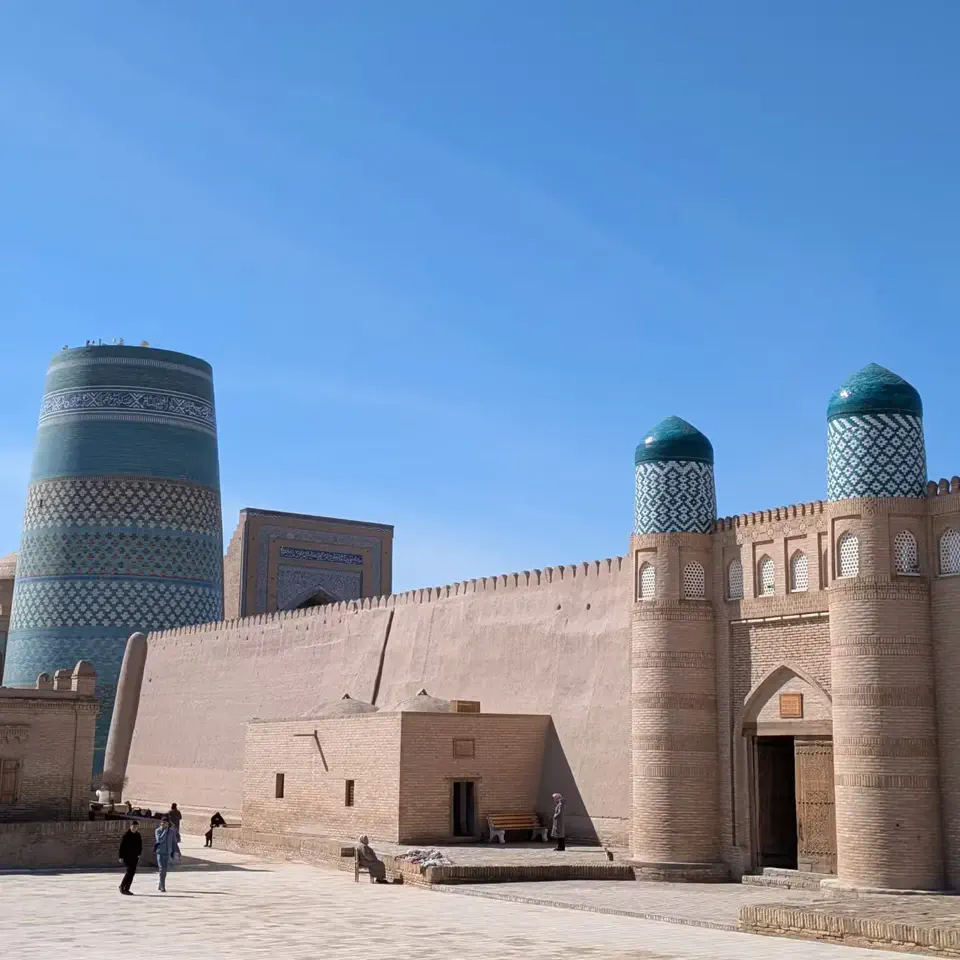
Uzbekistan
Uzbekistan… the name alone evokes the splendors of the Orient!
Welcome to Uzbekistan, in the heart of Central Asia, a true crossroads of civilizations, where slender minarets, turquoise domes, and bustling alleyways tell centuries of history. Uzbekistan is the promise of a journey through time, following the traces of the legendary Silk Road, where merchants, scholars, and adventurers stopped between China and Europe.
Imagine a country with stunning heritage, where the mythical cities of Samarkand, Bukhara, and Khiva sparkle like jewels in the midst of the sands. Every stone, every fresco, every square tells a story more than two thousand years old. In the vibrant bazaars, the scents of spices, hot bread, and cardamom tea mingle with the smiles of artisans. Here, you’re welcomed with hot tea and an open heart, as Uzbek tradition dictates.
But Uzbekistan is not limited to its museum cities. Off the beaten path, you’ll also discover little-known landscapes: Tien Shan mountains, desert plateaus, isolated villages, and green oases. Hikes in the foothills of Nurata, nights in yurts under an infinite sky, donkey rides in countryside where time seems suspended… It’s a completely different face of Uzbekistan that awaits you.
And then there’s culture: a mosaic of Persian, Turkish, Russian, and nomadic influences. Dazzling dances, ancestral music, generous gastronomy — from savory pilaf, handmade mantis, to golden round breads from the tandoor. A trip to Uzbekistan is a total immersion in a sensory and human universe.
Do you dream of an authentic, living, deeply human Orient? Of a country where millennial history meets the most sincere hospitality? Uzbekistan awaits you. And at Nomadistan, we’ll be delighted to help you discover its treasures, at your pace, according to your desires.
If you’re ready to explore a country where adventure and hospitality blend into a delicious cocktail, if you dream of vast starry skies, galloping horses with manes flowing in the infinite steppes, and warm nights in yurts to feel the freedom of nomads, contact us! Share your desires and dreams with us, and we’ll be delighted to help you make them come true!
Essential Information
Practical Notebook
Flights
The Uzbek national carrier Uzbekistan Airways offers direct flights from Paris to Tashkent.
The Turkish carriers Turkish Airlines, Pegasus, and Ajet, the Qatari carrier Qatar Airways, and the German carrier Lufthansa offer regular flights with stopovers to Uzbekistan.
Tip: with some airlines, it’s possible to arrive in Urgench (very close to Khiva) and depart from Tashkent, or vice versa, which avoids having to cross the entire country again once your tour is complete.
Time Difference
You need to add +3 hours in summer and +4 hours in winter compared to Paris time.
Currency and Exchange
The national currency is the Uzbek som (UZS): €1 equals approximately 13,500 som. As the exchange rate varies greatly, it’s recommended to check it regularly before your departure or during your stay.
In major cities like Tashkent, Samarkand, or Bukhara, it’s very easy to exchange currency, whether at the airport, in banks, or at official exchange offices. The use of bank cards is developing, but it remains prudent to always have cash on hand, especially in more rural regions.
Banks and ATMs
International MasterCard and Visa cards are accepted in Uzbekistan, particularly in hotels, restaurants, and shops in major cities. Contactless payment is developing rapidly.
However, in many situations, cash payment remains common, particularly in bazaars, small shops, or in rural areas. It’s therefore better to plan for sufficient change and small bills, as exact change is often necessary.
SIM Cards and Internet
It’s very simple and inexpensive to buy a local SIM card in Uzbekistan, whether at the airport, in operator shops, or in local stalls. You’ll need your passport for registration at the time of purchase, in accordance with regulations. The main operators are Ucell, Beeline, Mobiuz, and UzMobile, which offer prepaid plans with calls, SMS, and mobile data.
4G coverage is good in major cities like Tashkent, Samarkand, and Bukhara, but can be limited in rural areas. 5G is being deployed, mainly in Tashkent.
International Dialing Code
Dial +998 to reach an Uzbek number from France, and +33 to reach a French number from Uzbekistan.
Electricity and Outlets
In Uzbekistan, electrical outlets are types C and F, and the voltage is 220 volts with a frequency of 50 Hz, exactly like in France. No adapter is necessary for French travelers: you can plug in your electronic devices directly.
⬆️ Back to Menu ⬆️ Back to Menu
Country Profile
Climate
Uzbekistan has a continental climate, with cold winters and hot, dry summers.
Tashkent: Winters from -5 to 5°C, summers from 25 to 35°C.
Samarkand and Bukhara: Similar, but hotter in summer, reaching up to 40°C.
Khiva: Desert climate, very hot summers, mild winters.
The best time to visit is spring (March-May) or autumn (September-November) to avoid extremes.
Ethnic Groups
Uzbekistan has several ethnic groups, with Uzbeks (about 80% of the population), Russians (5%), Tajiks (4%), Kazakhs (3%), and other minorities such as Tatars, Koreans, and Ukrainians. This ethnic diversity is the result of the country’s history under the Soviet Union.
Religions
Uzbekistan is a predominantly Muslim country (about 90% of the population). Uzbeks follow moderate Sunni Islam and are tolerant. From a cultural and historical perspective, Uzbek women often cover their heads in religious places. Outside mosque visits, there’s no need to adopt a specific dress code. There’s also an Orthodox Christian community, made up of Russians and other ethnic minorities.
Gastronomy
Uzbek cuisine is generous and flavorful, the result of a mixture of Persian, Turkish, and Russian influences. It highlights hearty dishes, spices, and fresh products from the bazaars.
Must-Try Dishes
- Plov — the national dish: pilaf rice cooked with meat (usually mutton or beef), carrots, onions, and spices; dried fruits are often added.
- Manty — large steamed dumplings, most often filled with meat, served with sour cream or sauce.
- Samsa — triangles of dough (often baked in a tandoor) filled with meat or vegetables.
- Laghman — dish of Uyghur origin: long handmade noodles, served with vegetables and meat, sometimes spicy.
- Achichuk — cold tomato and onion salad/soup, often consumed as a side dish.
Desserts and Snacks
- Chak-chak — small fried dough bites bound with honey and often garnished with raisins.
- Halva — sweet made from seeds (often sunflower) or cereals, presented in different textures.
Beverages
- Green or black tea — served at any time, often accompanied by dried fruits.
- Kompot — homemade drink made from cooked fruits.
Vegetarianism
The vegetarian offering is expanding in major cities and it’s possible to find meatless options in many restaurants. However, in rural areas the choice remains limited and it’s advisable to plan alternatives or notify hosts in advance.
Customs and Traditions
Hospitality Hospitality is an essential value for Uzbeks. You won’t be able to leave someone’s home without having a cup of tea and eating something. Table seating follows specific rules: honored guests (often the eldest people, as well as guests from far away) preside over the table.
Your hosts will likely serve you directly on your plate to ensure you lack nothing. If you don’t appreciate certain dishes served, it’s better to taste a small bite and leave it on the corner of your plate rather than refuse to avoid offending.
Generally, Uzbeks serve generous portions and leave a lot of food on their plates, because custom dictates that all guests share the leftovers and take them home.
Finally, during large meals, everyone must make a toast and address a few words of celebration, appreciation, gratitude, or other positive sentiments to the other people present. You’ll surely be invited to do the same.
Religious sites When visiting religious sites, don’t forget to remove your shoes (in mosques), and for women, to cover your head and shoulders.
⬆️ Back to Menu ⬆️ Back to Menu
Health
Health
Vaccinations
Although no particular vaccine is required to enter Kazakhstan, it’s still recommended to have some vaccinations up to date, especially for universal vaccines such as BCG (tuberculosis), DT-Polio (diphtheria-tetanus-poliomyelitis), MMR (measles, mumps, and rubella), hepatitis A and B, and whooping cough.
Insects
Remember to bring mosquito repellent for the warmer regions. During mountain or forest excursions, remember to wear clothing covering your legs and arms as well as a hat, to protect yourself from possible ticks (especially present in May and June).
Healthcare Access
Major cities such as Astana and Almaty have medical offices and private clinics well equipped and offering quality care by staff, some of whom are English-speaking. In smaller towns and villages, access to healthcare may be of more uneven quality. As with any trip, we recommend choosing good quality insurance and bringing a first aid kit.
Drinking Water
Tap water is not potable. It’s recommended to consume bottled water or use a filtering bottle like “life-straw.”
⬆️ Back to Menu ⬆️ Back to Menu
Safety
Kazakhstan is renowned as a safe country for travelers. It’s unfortunately often wrongly confused, because of “the stan” in its name, with Afghanistan and Pakistan, which is detrimental to it. Kazakhstan is a welcoming country for tourists, and foreigners are received with warmth and kindness, a legacy of the legendary nomadic hospitality.
Although the country presents no particular risk, as with any trip, it’s advisable to follow common sense and usual basic precautions.
If you are a French citizen, you can register on Fil d’Ariane, a public service that will allow you to receive any alerts corresponding to your travel area. Most countries offer similar travel warning systems for their citizens.