Kazakhstan
Kazakh… what?
Welcome to Kazakhstan, the “Land of the Kazakhs,” a vast country where endless stretches of steppe meet the majestic peaks of mountains. Originally, the word “Kazakh” would mean “free man,” making Kazakhstan the “Land of Free People.” An enticing prospect, isn’t it?
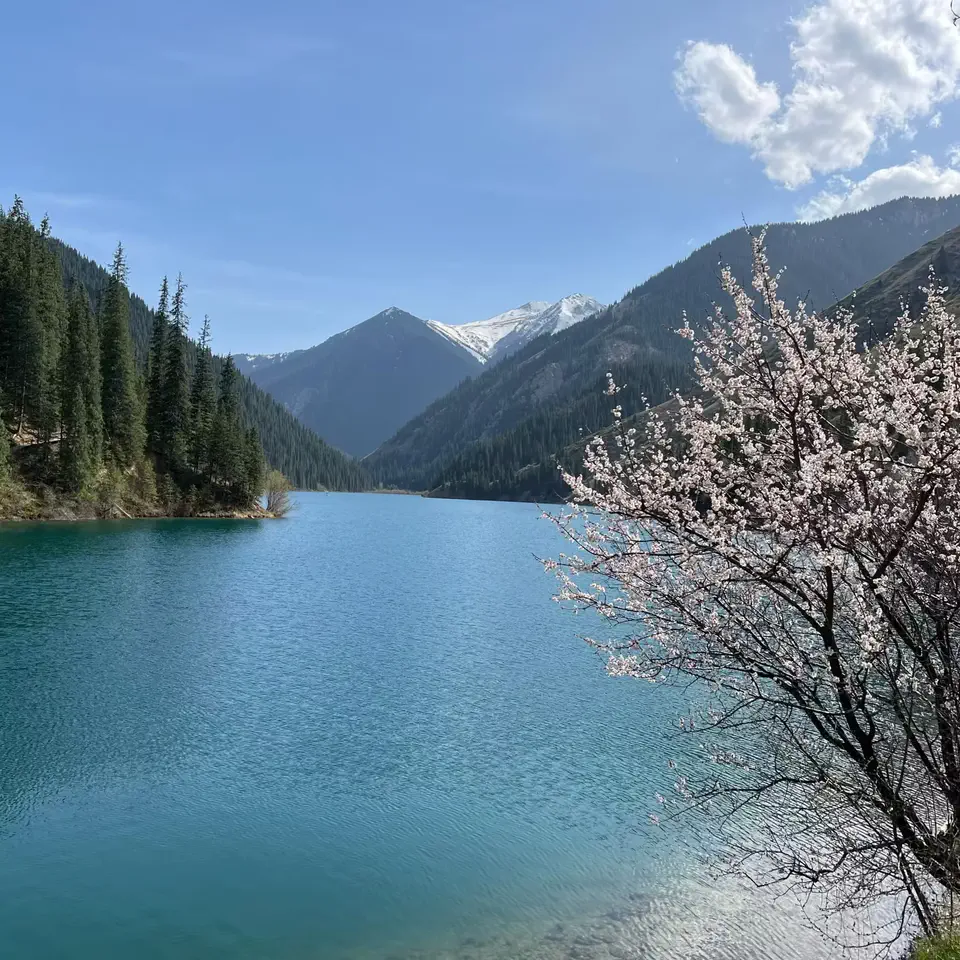
Imagine a country, the ninth largest in the world, where landscapes range from steppes as far as the eye can see, snow-capped peaks rising above seven thousand meters, multicolored canyons, sand dunes, shimmering lakes, ancient forests, a turquoise sea, deserts, and even the remnants of a prehistoric ocean. From north to south, east to west, Kazakhstan offers breathtaking landscapes and unforgettable vistas.
Whether you’re a nature lover, culture enthusiast, adventurer, or all of the above, Kazakhstan will captivate you. Hiking on foot, horseback, bicycle, or ski are among the many activities available to you. With its nature reserves listed as UNESCO World Heritage Sites, Kazakhstan is home to numerous protected species, such as the saiga antelope, Central Asian brown bear, Przewalski’s horse, imperial eagle, bearded vulture, Dalmatian pelican, Caspian seal, gray wolf, and the very rare snow leopard.
Now let’s talk about culture. Kazakhstan will delight you with its ancestral traditions, mesmerizing folk music, generous cuisine, and an unparalleled sense of hospitality that will make you feel immediately at home. It’s no coincidence that the yurt, the traditional home of the Kazakhs, is nicknamed “the hotel of a thousand stars.” In Kazakhstan, traditional identity and modernity coexist harmoniously.
So what are the iconic places in this magnificent country? While Almaty, the cultural capital, and its region are unmissable, the lunar landscapes and sunsets on the shores of the Caspian Sea in the Mangystau region will leave you with lasting memories. Just like the sacred mountains of Altai in East Kazakhstan, the ancient city of Turkestan with its splendid medieval mausoleum built on Tamerlane’s orders in the south; and the futuristic capital, Astana, a veritable “Dubai of the steppes” in the north. There are so many little-known and captivating places that we’re eager to help you discover with Nomadistan.
If you’re ready to explore a country where adventure and hospitality blend into a delicious cocktail, if you dream of vast starry skies, galloping horses with manes flowing in the infinite steppes, and warm nights in yurts to feel the freedom of nomads, contact us! Share your desires and dreams with us, and we’ll be delighted to help you make them come true!
Essential Information
Practical Notebook
Flights
The German national carrier Lufthansa, Turkish carrier Turkish Airlines, Qatari carrier Qatar Airways, as well as the Turkish low-cost airline Pegasus, offer regular flights to Kazakhstan.
Depending on the time of year, round-trip flights from Paris to Aktau, Astana, or Almaty can be found starting at €490. For domestic flights, Air Astana offers high-quality service. Its low-cost subsidiary FlyArystan is also reputable and safe.
Time Difference
Since March 1, 2024, there is only one time zone throughout Kazakhstan. You need to add +3 hours in summer and +4 hours in winter compared to Paris time.
Currency and Exchange
The national currency is the tenge (KZT): €1 equals approximately 570 tenge. The tenge exchange rate fluctuates, so don’t hesitate to check the rate regularly.
In major cities, it’s very easy to exchange currency, whether at the airport, in banks, or at exchange offices (which can be found on every street corner).
Banks and ATMs
International MasterCard and Visa cards are widely accepted in Kazakhstan. Contactless payment is very common. Since Kazakhstanis now widely use electronic payments (via an app called “Kaspi”), when you want to pay in cash (or when card payment is not accepted), it’s better to have exact change: keep your coins carefully!
SIM Cards and Internet
It’s very simple and inexpensive to buy a local SIM card in Kazakhstan, whether at the airport, in operator shops, or in a small street stall. You’ll need your passport to register at the time of (or after) purchase. Given the size of the country, there are many areas without network coverage (in the steppes or mountainous areas), but in cities, coverage is generally good, with 4G. 5G is gradually being introduced.
International Dialing Code
Dial +7 to reach a Kazakh number from France, and +33 to reach a French number from Kazakhstan.
Electricity and Outlets
The electrical outlets (types C and F) and voltage (220V) are identical in France and Kazakhstan: therefore, no adapter is needed.
⬆️ Back to Menu ⬆️ Back to Menu
Country Profile
Climate
Due to its immense geographical expanse, Kazakhstan offers remarkable climatic diversity.
Almaty and its region (Southeast): Winters are cold (-5 to -15°C) and snowy, offering good conditions for alpine skiing and ski touring (from late November to late April). Spring is mild (10-20°C) with regular showers, allowing nature to bud and turn green vigorously. Summers are hot (25-35°C), making it an excellent season to enjoy mountain meadows and valleys. Autumn is generally very sunny, with pleasant temperatures (10-20°C), providing optimal weather for strolling in the southern capital, Almaty.
East Kazakhstan Region (East): Cold, dry winters (-15 to -20°C) give way to hot summers (20 to 30°C). Spring is gradually mild (5-15°C), and autumn is cool (5-15°C). The best season for treks to Mount Belukha in Katon-Karagay National Park extends from late June to mid-August.
Mangystau Region (West): Mild winters (-5 to 5°C) contrast with hot summers (25 to 35°C), during which it’s pleasant to cool off in the clear waters of the Caspian Sea. Spring is moderate (5-15°C), and autumn is mild (5-15°C).
Turkestan Region (South): Mild winters (0 to 5°C) give way to very hot summers (30 to 40°C). Spring (15-25°C) and autumn (15-25°C) are the most pleasant seasons to visit southern Kazakhstan. In early spring, the endless fields of tulips are a feast for the eyes.
Astana (Center-North): Winters are extremely cold and long (October to April) with average temperatures of -20 to -40°C. Summers are brief (July and August) and hot (20 to 30°C). Astana is the second coldest capital in the world after Mongolia’s Ulaanbaatar: an experience not to be missed!
Ethnic Groups
Kazakhstan has more than 130 official ethnic groups, due to its history, particularly during the Soviet Union era. Many peoples deemed insufficiently compliant by Soviet leaders were deported to the vast Kazakh steppes. The ethnic groups with the most members are Kazakhs (nearly 71% of the population), Russians (nearly 15%), Ukrainians (3.9%), Uzbeks (3.2%), Uyghurs (1.5%), Tatars (1.1%), and Germans (1.1%). But you also find Koreans (of North Korean origin, deported by Stalin), Dungans (Chinese of Muslim origin, also known as “Hui”), and even Turks. Every year on May 1st, Kazakhstan celebrates its diversity and inter-ethnicity during “People’s Unity Day.”
Religions
Kazakhstan is a predominantly Muslim country (about 70% of the population). Kazakhs follow a moderate Islam and are tolerant. From a cultural and historical perspective, Kazakh women have never been veiled. Except when visiting mosques or other religious sites (including Orthodox churches), there’s no need to cover your head or adopt a specific dress code. During Ramadan, the vast majority of restaurants operate during regular hours. Crowds may simply be larger. There is also a large Orthodox Christian community (20% of residents), made up of ethnic Russians, Ukrainians, and Belarusians.
Gastronomy
Kazakh cuisine is generally hearty, rich in meat and dairy products, reflecting nomadic life and the region’s extreme climatic conditions. Here are some emblematic delights of Kazakhstan:
Must-try dishes: Beshbarmak or “Kazakh et” is the Kazakh national dish. It consists of boiled meat (mutton, beef, or horse) cut into pieces, served on a bed of pasta. It’s often accompanied by broth, onions, and potatoes.
Syrne is another essential dish in Kazakhstan. A young lamb is slowly cooked in a pot over a fire until the meat is very tender. In some regions, onions, potatoes, and other vegetables are added.
Kazy is a horse sausage, often found in the national dish, beshbarmak.
Koktal is a large fish, smoked in a special metal box. Prepared with chopped tomatoes and onions, the fish is cut along the backbone, leaving the scales intact.
Soups: Nauryz Kozhe is a traditional soup prepared and served throughout the month of March, for the Kazakh New Year, Nauryz. It’s made from seven main ingredients, symbolizing the seven elements of life.
Kespe (“noodles”) tops the list among local soups! Beef, lamb, or horse meat is used for this soup. The meat must still be on the bone to make the broth. Before serving kespe, carrots, herbs, and homemade noodles are added to the broth.
Dishes of foreign origin found throughout Central Asia:
Manty are large dumplings, usually stuffed with mutton or beef, sometimes with pumpkin or potato. They’re steamed and served with sour cream.
Laghman is a dish of Uyghur origin: long hand-pulled noodles, accompanied by vegetables and meat, and often (very) spicy. They’re served in soup or stir-fried.
Plov is of Uzbek origin: a pilaf rice dish mixed with meat (usually mutton or beef, sometimes chicken), carrots, onions, and spices. It can also contain dried fruit.
Samsa are triangles of puff pastry, filled with meat and baked in a tandoor oven.
Pelmeni, like manty, are of Russian origin. These small dumplings are often filled with meat and served with sour cream. There’s a potato-based version (without meat) called vareniki.
Desserts and snacks: Baursak are small fried dough breads, often accompanied by jam or honey.
Kurt is THE Kazakh cheese. It comes in the form of small hard balls of dried, salted cheese.
Chak-chak is a very popular Tatar dessert in Kazakhstan. It’s made of fried dough dipped in honey and raisins.
Irimishik is similar to cottage cheese. It has a slightly sweet taste without containing added sugar.
Zhent is a Kazakh dessert made of crushed cottage cheese, millet, sugar, raisins, and butter.
Beverages: Kumis, made from fermented mare’s milk, is Kazakhstan’s emblematic drink.
Shubat is a drink made from fermented camel’s milk.
Note on vegetarianism: The vegetarian (and even vegan) offering is expanding in major cities, with meatless options in many restaurants, and even some vegan cafes.
But generally speaking, vegetarianism is not yet among the dietary habits best understood by Kazakhs, especially in rural areas.
Customs and Traditions
Hospitality Hospitality is an essential value for Kazakhs. You won’t be able to leave someone’s home without having a cup of tea and eating something. Table seating follows specific rules: honored guests (often the eldest people, as well as guests from far away) preside over the table (opposite the door).
Your hosts will likely serve you directly on your plate to ensure you lack nothing. If you don’t appreciate certain dishes served, it’s better to taste a small bite and leave it on the corner of your plate rather than refuse to avoid offending.
Generally, Kazakhs serve generous portions and leave a lot of food on their plates, because custom dictates that all guests share the leftovers and take them home.
Finally, during large meals, everyone must make a toast and address a few words of celebration, appreciation, gratitude, or other positive sentiments to the other people present. You’ll surely be invited to do the same.
Religious sites When visiting religious sites, don’t forget to remove your shoes (in mosques), and for women, to cover your head (mosques and Orthodox churches) and shoulders.
Yurts When entering a yurt, take care to step over the threshold and put your right foot down first. Entering with your left foot first would signify that you’re arriving with bad intentions.
⬆️ Back to Menu ⬆️ Back to Menu
Health
Health
Vaccinations
Although no particular vaccine is required to enter Kazakhstan, it’s still recommended to have some vaccinations up to date, especially for universal vaccines such as BCG (tuberculosis), DT-Polio (diphtheria-tetanus-poliomyelitis), MMR (measles, mumps, and rubella), hepatitis A and B, and whooping cough.
Insects
Remember to bring mosquito repellent for the warmer regions. During mountain or forest excursions, remember to wear clothing covering your legs and arms as well as a hat, to protect yourself from possible ticks (especially present in May and June).
Healthcare Access
Major cities such as Astana and Almaty have medical offices and private clinics well equipped and offering quality care by staff, some of whom are English-speaking. In smaller towns and villages, access to healthcare may be of more uneven quality. As with any trip, we recommend choosing good quality insurance and bringing a first aid kit.
Drinking Water
Tap water is not potable. It’s recommended to consume bottled water or use a filtering bottle like “life-straw.”
⬆️ Back to Menu ⬆️ Back to Menu
Safety
Kazakhstan is renowned as a safe country for travelers. It’s unfortunately often wrongly confused, because of “the stan” in its name, with Afghanistan and Pakistan, which is detrimental to it. Kazakhstan is a welcoming country for tourists, and foreigners are received with warmth and kindness, a legacy of the legendary nomadic hospitality.
Although the country presents no particular risk, as with any trip, it’s advisable to follow common sense and usual basic precautions.
If you are a French citizen, you can register on Fil d’Ariane, a public service that will allow you to receive any alerts corresponding to your travel area. Most countries offer similar travel warning systems for their citizens.