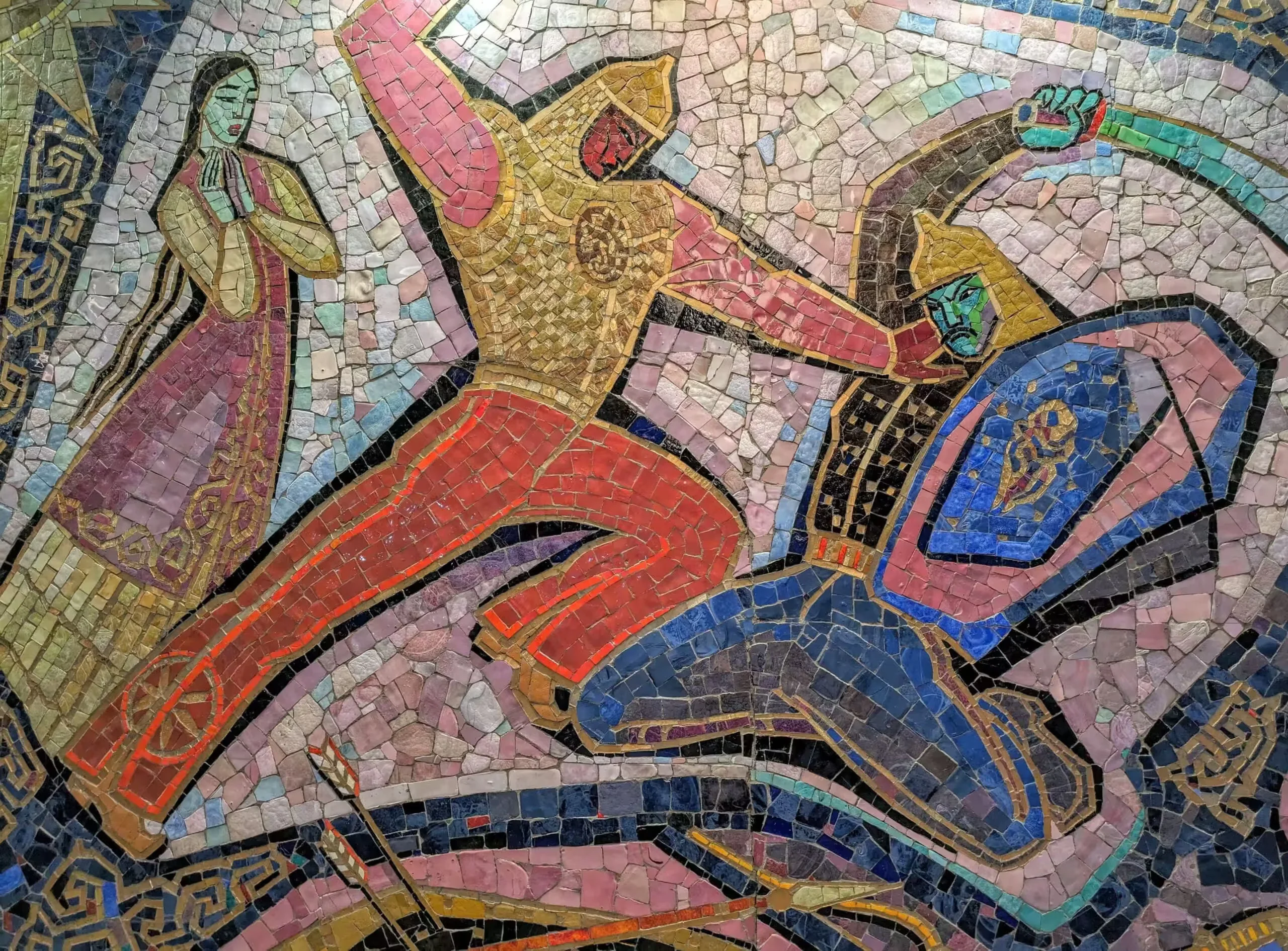
The mosaics of Almaty, particularly the representation of the Kazakh folk tale "Enlik and Kebek" on the facade of the Almaty Hotel, are considered masterpieces of monumental art from the Soviet era. These, delicately crafted from glass tiles, adorn the city's walls. Some of them don't reveal themselves easily to passersby, and it takes a trained eye to spot them.
What particularly distinguishes the "Enlik and Kebek" mosaic is a fascinating discovery shared by Dennis Keen, an American passionate about Kazakh culture and Soviet art: when examining the mosaic closely, two tiles bearing initials reveal intriguing origins: the Russian Imperial Glass Factory for one and an Italian artisan for the other. How is it that we find this Italian name on a mosaic wall in Kazakhstan? Leopoldo Bonafede, a Roman, was summoned by Tsar Nicholas I to direct the Russian mosaic workshop, initially established in Rome in 1846 and transferred to Saint Petersburg ten years later. Bonafede was one of the brightest students of the famous mosaicist Michelangelo Barberi in Rome. His vast knowledge of chemistry allowed him to significantly advance enameling techniques, producing pieces of exceptional quality.
These details of the mosaic highlight how international exchanges of artistic techniques during the Soviet era converged to create remarkable works.
Now let's return to our folk tale!
The tale of Enlik and Kebek dates back to an 18th-century Kazakh legend, meticulously documented by Shakarim Kudaiberdiev, a Kazakh poet, philosopher and historian, in a poem published in 1912. Mukhtar Auezov, a renowned Kazakh writer and playwright, then brought this legend to a wider audience through his play "Enlik — Kebek", considered a pillar of Kazakh theater.
The story of Enlik and Kebek unfolds against a backdrop of rivalries between two Kazakh tribes. Enlik, a talented young woman from the Naiman tribe, is betrothed in childhood to a relative's brother, Yesen. However, she falls in love with Kebek, a proud warrior from the Tobykty tribe. Enlik and Kebek, defying social conventions, flee to the Orda mountains to live their forbidden love and give birth to their son.
On the mosaic, the evil Yesen (in blue) appears to be defeated. However, happy endings are not on the agenda in traditional Kazakh love stories. The lives of Enlik and Kebek thus end tragically, when the elders of their tribes sentence them to death for their disobedience. Caught and finally executed, Enlik and Kebek meet a fate similar to that of Shakespeare's Romeo and Juliet.
